Showing posts with label book review. Show all posts

Sunday, June 19, 2016

Nitro Mountain by Lee Clay Johnson


“Do you know what growing up means? It means learning how to beat a woman. Trying to kill a man. Posting up at a worn-out palace with a loaded gun and waiting to deal with the consequences of what you’ve done.”

I don’t think I’ve ever taken my own picture for a book review before, but it feels right for this one. I took it with me on a weekend camping trip and found a spot next to a stream to finish it. Nature has a personality in Nitro Mountain, and not a good one. Being in nature was a great way to get into the book but when I was done, the woods seemed a little less friendly.

Nitro Mountain is the connected stories of several people in Bordon, a nothing little town in the Virginia wilderness. The book starts with Leon, who plays bass with a broken arm. It drifts on to drug-dealer Arnett and later, his girlfriend Jennifer. Other characters make appearances: a talented but aimless musician, a suspended sheriff looking for a chance to get his job back. Others- parents, ex-wives, waitresses and mentoring bartenders- get a mention or two. Some are just looking for direction and some are deeply psychotic. Some mostly hurt themselves, some go a long way to hurt others, most do a little of both. All of them are trapped in the same kind of life, shaped by poverty, drinking, and violence. For them,  abuse and addiction are like bad weather: unlucky but a part of life no one can avoid. The book winds from one life to the next, through missed court dates, bluegrass shows, days spent at dead end jobs and nights spent drinking at the same bars. 


Above all of it is Nitro Mountain. At first the mountain is just a bleak backdrop of bare-branched white oaks and foggy pine valleys. But the woods are a place for people to hide and things to be hidden. Vultures and “corpse-like cattle” make their home in it, next to even more ominous animals. The mountain becomes a brutal, apathetic witness to the lives of Leon, Jennifer, Arnett, and the other people of Bordon. It surrounds them and rises over them, putting the town in its shadow. It watches how they waste their days, watches the creative ways they hurt the people they care about, and it watches all their dead-ended attempts to escape the circuit of pain and hopelessness that runs through their town. 

Sunday, August 24, 2014

Etta Mae's Worst Bad Luck Day by Ann B. Ross


“Pushing aside the hangers in the closet, I pulled out by newest and best dress that I’d worn to church on Easter and only a couple of times since then. I was real proud of it because it was a designer dress from the Kathie Lee Collection at Walmart’s and looked like a million dollars on me. If I’d had the chance, I’d have bought something new for my wedding, but at least this was mostly white. A quality 100 percent rayon classic white dress with black polka dots. Signifying, I guess, my marital experiences of the past.”

Some people may recognize the author of Etta Mae's Worst Bad Luck Day, as well as the small town of Abbottsville, North Carolina, where the book takes place. Ann B. Ross is the writer of the well-known Miss Julia series. But this book follows a different character: Etta Mae Wiggins, who appears in the Miss Julia books but has never had a story of her own before.

Etta Mae is a tough but good-hearted young woman who, tired of being written off as trailer trash, has come up with a plan to finally get ahead in life. That plan is to tie the knot with the elderly and well-off Mr. Howard Connard, for whom she works as a home nurse.  Surely, she believes, Etta Mae Connard will command the respect Etta Mae Wiggins never could, and in the process she can brighten an old man's life, however much he has left. As Etta Mae anticipates the approaching wedding— velvet-clad bridesmaids, baby’s breath bouquets and all—things are complicated by the appearance of two unwelcome faces: Mr. Connard’s ill-tempered son and one of Etta Mae’s deadbeat ex-husbands.

Etta Mae is a charming heroine, immediately sympathetic for her pragmatism, kindness, and Southern style. Despite the book’s humor, this makes for some profoundly sad moments when we see Etta Mae crushed by the shallow judgments of her neighbors. The story has some elements of a mystery—a crime, an unknown perpetrator-- but doesn’t have a lot of tension or gravity; instead, what makes it an easy and enjoyable read is how Etta Mae deals with the many roadblocks on her path to a better life.  

If you would like a copy of this book, leave a comment with an email address and I will choose a random winner in a few days. 

Thursday, July 31, 2014

Dear Daughter by Elizabeth Little


“I stepped forward and pushed open the front door—which promptly fell off its hinges. I caught it just as it hit the floor, the crack of wood on wood echoing through the hall. I went still and silent and waited. For the sound of footsteps. For the sound of voices. But, thank god, no one came.

I replaced the door as best I could and peered around. Your standard foyer, with two large rooms on either side. I had stirred up dust with my graceless entry and for a brief moment the sun refracted through motes so profuse the air glittered like a fairy glen. But then the dust settled, and the room took on the hue of the water at the bottom of a tub after you plunge up a muck of soap-scummed hair."

Jane Jenkins is the star of Dear Daughter, and we meet her moments after she’s released from prison on a legal technicality, having been convicted for the murder of her manipulative socialite mother. Instead of trying to return to her old life in L.A., dating actors and starving for fame, Jane dons a disguise and flees across the country to look for the truth about the night of the killing, a night she can’t recall well enough to know if she committed the crime or not. Her pursuit takes her to a tiny, stagnant town in the Midwest, the kind of place that carefully keeps its secrets.

Elizabeth Little’s first novel stars a complex protagonist with a voice and personality that really shine. Every page drips with Jane’s bitterness and sharp humor; Little pries deep into Jane's psyche, uncovering damages from a decade in prison and a lifetime as a scapegoat for her apparently flawless mother. The descriptions genuinely feel like Jane’s own words so readers get to see the people and places in the book through the unique lens of someone who is both a released convict and a former Hollywood darling.

A solid mystery, the book holds a handful of surprises although only one or two feel really meaningful. All in all, it was entertaining with a pace that picked up in the second half, and a book where I'll probably remember the protagonist more than I'll remember the story. 

You can buy Dear Daughter on Amazon here or you can win a free copy by commenting here with your email. US only.

Thursday, November 28, 2013

City of Lost Dreams by Magnus Flyte


City of Lost Dreams follows a musicologist named Sarah as she tries to save Pollina, a young piano prodigy, from a serious illness. With the help of her friends, an immortal dwarf and a Czech prince, Sarah looks for a missing doctor; her search gets complicated and dangerous as the past and present bleed together on the streets of Vienna and Prague. 

This is the second book in a series and the first series where I’ve read the sequel first. There are plenty of references to an eventful history but I generally didn’t find myself confused or missing out. However I'm definitely going to find the first one, City of Dark Magic, soon.


City of Lost Dreams is a vibrant story where even minor characters are colorful and deep. The grandiose cities seem otherworldly and the blend of science, history, and magic are really charming. There are a number of images and sensations that recur throughout the story and are described so well that they stuck with me, from an automated golden galleon to the music of a glass armonica to a horse barn on fire. There are some scenes that are so heavily visual and abstract that I did have trouble imagining them, but for the most part, Flyte (who is actually two authers) writes so vividly I feel like I’m still in that mystical version of Europe.

You can get City of Lost Dreams on Amazon here.

Wednesday, September 18, 2013

Who Asked You by Terry McMillan


When I need to describe a good book, I usually use words like ‘enjoyable,’ ‘fascinating,’ ‘well-written,’ but I don’t really think of books as ‘fun,’ not because I don’t like reading them but because ‘fun’ makes me think of riding roller coasters.  But Who Asked You is just a fun book. It was a blast to read, and what makes that even weirder to say is that it touches on some sad, serious problems like addiction, divorce, and crime. There are some real heartbreaking parts but the book is, overall, optimistic and charming.

Who Asked You tells the story of an extended black family in California during the early 2000s. The first character we meet is Betty Jean, who’s taking care of her grandsons after their addict mother drops them off. The narrative soon expands to include her sisters, their families and some of their friends. There are quite a few narrators, in and outside the family. Some of them appear just once and one doesn't even get a name. The occasional chapter by a child narrator adds some levity and I appreciated the variety of voices, from Quentin’s mildly pretentious vocabulary to Lee’s short, fractured trains of thought.

I'm used to a traditional story structure of rising action and a climax, I was a little lost when I finished the book and found that hadn’t happened. There are dramatic events but they don’t really build to a boiling point. They just kind of happen, one after another with no particular plan, just like they do in real life. For a book that mimics the pace of the real world so well, the ending was oddly neat and convenient. Almost everyone gets an extremely happy ending. The way it wraps up doesn’t leave a lot to think about but left me with a nice feeling at the last page.

Terry McMillan has written a couple other novels, including How Stella Got Her Groove Back. If you want to read this book, leave a post with contact info and I'll pick a random commenter in a few days. 

Thursday, August 15, 2013

Necessary Errors by Caleb Crain


Admittedly, I didn't finish this book so keep that in mind with this review. I really tried but eventually it felt like too much of a chore to open it and I gave up at about 300 pages. I feel like I just didn't get it. It gave the impression it has a lot to say about capitalism, culture clashes, and being an American abroad; maybe someone more familiar with philosophy and history would have found something to sink their teeth into. Mostly, I was bored. It was impossible to read more than 20 pages at a time. I had no problems with the prose style and sometimes Crain paints a charming scene, it was just a tedious story. There’s no urgency, intensity, or weight to the protagonist’s situation. Jacob floats from scene to scene without appearing to feel much or care about anything and I was not at all invested in him or his friends. The book is a long string of self-contained scenes: Jacob buys a hamster, Jacob gets a boyfriend, Jacob goes to Berlin, Jacob tutors some Czech children, and so on- you could just cut most of them up and put them in any order without changing the story’s impact. Some of the snapshots do sparkle with real tension or tenderness but most of them seem inane if pleasantly written, with no bearing on each other or the greater arc of the story. 

One thing I can say is that I liked the dreamy, almost fantasy-like portrait of Prague. In an interview, Crain quoted another author as saying “Every writer needs a fairyland” – not a Middle Earth or Hogwarts exactly, but some setting that is almost but not quite like the real world. To me and probably to a lot of Americans, Crane’s Prague is certainly that, with its unpredictable food shortages and numerous linguistic quirks. It just wasn’t enough to outweigh the carefully-maintained detachment that colors every character.

If you want to see for yourself, leave a comment and I'll choose one person to receive a copy.  


Saturday, July 20, 2013

The Thinking Woman's Guide to Real Magic by Emily Croy Barker


New Jersey native Nora, stinging from a recent breakup, stumbles through a portal into the clutches of the Faitoren, a race of capricious illusionists with sinister plans for her.

A novel with a solid, classic fantasy feel. Even the cover looks vintage, like a sword-and-sorcery paperback from the 80s and the story carries some of that influence as well, complete with its own flavor of magical mechanics and quite a few constant-heavy names. It’s got a relaxed pace and tension that builds at a really slow boil, making it a comfortable book I looked forward to reading before bed. What little romance there is serves as a nice accent rather than a the main attraction and it feels authentic in its evolution. I do wish Nora had been a little more active in her own fate, not because her passivity didn't make sense in the context of the story, just because I wanted her to control her own direction a bit better. At one point, she (almost) sets out on her own and that was an exciting turn of events but it didn't pan out. The other characters are provide interesting glimpses of a much larger world and a dense history. I hope there are more books in the future that expand on this as well as the next part of Nora’s journey; the story ends with a cliff hanger and there’s a lot that needs to be wrapped up. Some of it would have been better done in this book because there were some questions I thought shouldn’t have gone unanswered, but it does make me look forward to the next book.

There is a copy of this book available for giveaway. If you'd like it, leave a comment with a way to contact you and in a week or so I'll randomly pick a winner.

Saturday, June 22, 2013

The Never List by Koethi Zan


I got my hands on this book late yesterday morning and finished it by 10:00 PM. It was immediately gripping and I barely put it down. The Never List centers on Sarah, one of three women who survived years of unimaginable torment in the cellar of a sadistic criminal. When the date of her torturer’s parole creeps up on her, she is driven out of her cocoon to look for one last bit of closure.


The book moves along so smoothly you barely realize you’re reading, although parts of it are stomach-turning and heartbreaking, especially considering how similar the fictional events are to the recent crimes in Cleveland. Sometimes, we brush up against the scary complexity of the psychology of both sociopaths and their victims, but never quite dig into anything truly and memorably insightful. Nevertheless, I was definitely entertained and I think this would be a great book to bring on a weekend vacation or a long airplane trip. If you happen to have one of those coming up, comment on this blog before the week is over over with your email and you might win a free copy. Let's be honest, your odds are pretty good.

Here is a Spotify playlist provided by the author, in case you really want to get yourself in the mood while reading this book. 

The Lemon Orchard by Luanne Rice

Because I only come to town once or twice a week, my book reviews are stacking up so you get three in one day! Here's the second.

The Lemon Orchard:

Julia and Roberto, two people from vastly different lives, are able to connect through the pain of losing their children. As they find comfort in each other’s company, Julia becomes obsessed with solving the mystery of what happened to Roberto’s daughter.  


The star of this story is the landscape. The seaside lemon orchard in California gets a glowing tribute, especially during the a wildfire and the dusty Santa Ana winds. Maybe it’s just because I’m in the middle of a Louisiana forest in June but I’ve never wanted to be in the ocean more than I do when I’m reading about Julia and her daughter Jenny on the beach.


But there are two relationships that should be the backbone of this book: Julia and Roberto, and Julia and Jenny, but I found both of them lacking in sincerity and authenticity. Their interactions are too blatantly tailored to a predetermined arc rather than true to the way people naturally communicate and get to know each other. A particularly jarring example was during Roberto and Julia’s first meeting, when he presses her to tell him who Jenny is, despite her obvious discomfort and the fact that she’s basically his boss. It seems to me like something that might happen if a story was meticulously planned before characters were fleshed out to act in it. Julia and Roberto’s relationship continued to lag in believability and development until it turned into a chore to read about them. At the same time, the story of Rosa unfolds into a far more interesting plotline and I was tempted to skip the ‘romantic’ parts to find out what happened to her. I was often baffled by a character’s thought process and didn’t really follow a lot of the motivations. In the end, the resolution of Rosa’s disappearance was satisfying, but Julia and Roberto continued to confuse me until the very last page.  

If you would like to find out for yourself, you can! Comment on this entry with your email and on Monday I will pick a poster at random and get in touch with them to send a free copy of The Lemon Orchard.

Glow by Jessica Maria Tuccelli


Glow starts as the story of one woman and her daughter, caught in the danger of organizing a civil rights protest. It spirals outward to connect characters over hundreds of miles and several generations, using multiple narrators from the present and past to span the gap. Willie is the brightest part of the story and by far my favorite narrator, despite her introduction as a minor character. Her chapters are electric, encompassing some of the most heartbreaking and earnestly happy scenes in the book. All the other narrators expertly tell their own stories in engaging voices, except for one, who was so verbose I would often get lost, but only one chapter is from his point of view. Glow deals with the complex spectrum of early American racism, showcasing characters who are slaves, Native Americans, people of mixed parentage, or children of immigrants. It’s a painful and wistfully beautiful book with a heavy dash of the supernatural.

Tuesday, April 23, 2013

Virgin Soul by Judy Juanita


“God, San Francisco was such a thief. A lady of the night, a sorceress with her hands out...we had to pay to get in, pay to get out, pay for every little thing. ... Pay for the Pacific Ocean and the beach. I am expensive, the city always said, so pay me for my wonderful dark treats..."

Virgin Soul is set in the San Francisco of the 1960s, a tumultuous time and place in American history and, unfortunately, not one I know much about. I procrastinated on this review a bit because what can I possibly say about its accuracy or its authenticity? I have a feeling I wasn’t as emotionally connected to the actual people and events in the books as I should have been, because I couldn’t tell what was real and what was fiction until I looked it up later. But I can tell you the driving force of this novel for me is the heroine’s frank, simple appeal. I was on her side as soon as she peed in the elevator of a decadent clothing boutique. I can tell you the book made San Francisco seem like a hungry living thing and the narrator’s voice gives the whole story an electric feeling like something big is always about to happen. And I can say I found common ground with Geniece’s big ideas, the same I think any progressive kid from college would even if they came from a different background.

Although I don’t have much of a context to fit this story into, I appreciated the issues Geniece faces and the chance to read about the beginning of the black power movement. 

Tuesday, March 12, 2013

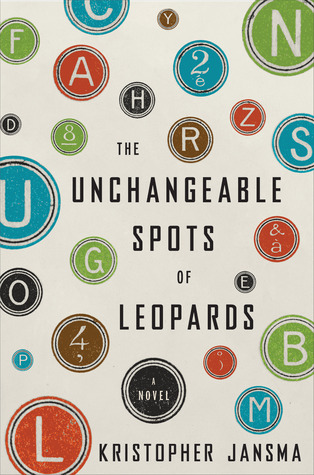
The Unchangeable Spots of Leopards by Kristopher Jansma


“As early as he can remember, the hopelessly unreliable- yet hopelessly earnest- narrator of this remarkable debut novel has wanted to become a writer.

From the jazz clubs of Manhattan to the villages of Sri Lanka, Kristopher Jansma’s irresistible narrator will be inspired and haunted by the success of this greatest friend and rival in writing, the eccentric and brilliantly talented Julian McGann, and endlessly enamored with Julian’s enchanting friend Evelyn, the green-eyed girl who got away. After the trio has a disastrous falling-out, desperate to tell the truth in his writing and to figure out who he really is, Jansma’s narrator finds himself caught in a never-ending web of lies.”

I got this book in the mail a few days ago and tossed it on my bed. Later, after a housewarming party, I came in and started reading it. Even though it was late and I was kind of drunk, it wrapped me up right away.  Immediately engaging, it begins with the narrator describing how he lost a manuscript- the first of many- in the airport terminal where his mother left him while she worked as a flight attendant. It follows his high school days working in a museum café, his meeting with Julian and Evelyn and his travels all over the world. Pieces of his own fiction crop up here and there, perfect complements to the truth but often indiscernible from it.

Writers and artists will especially like this book for a couple reasons. First, for the fantasy it presents as the lives of career writers who spend their time drinking Zubrowka vodka, going to Iceland, and quoting Hemingway at each other. Second because I think we can all identify with the jealousy of a friend with more talent. 

It’s a deceptively fast read with clean prose that hides a lot of insightful ideas and I felt a bit of a different  person after I finished it. I was reading about the narrator in Manhattan, Dubai, and Luxembourg, and I was thinking about how much I wanted to be in those places too, how I'd finally do interesting things and meet exciting people if I could only go to other places. Then there's a scene at the Grand Canyon and the narrator says out of all the wonders of the world, this is the only one that lives up to the hype. I only live a few hours from the Grand Canyon and I've never seen it. I live right next to other beautiful places I ignore and I live in a huge city full of people who are as interesting as people anywhere, but I don't even try to find them, I just keep waiting until I can go to France or whatever, which I'm not even sure I can ever do. So I booked a weekend trip to Sedona because I've never been there either and I'm bringing this book with me to read again. I don't know if this is a permanent change or just me feeling restless from reading so much about other places, but either way, I'm looking at my life in a new light and I think that's one of the most incredible things a book can do.

The Unchangeable Spots of the Leopard is Jansma's debut novel.

Wednesday, January 30, 2013

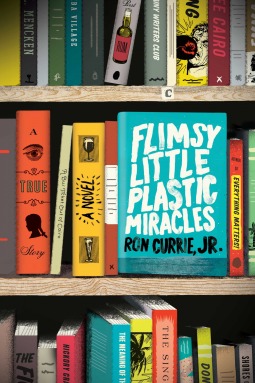
Flimsy Little Plastic Miracles by Ron Currie Jr


Flimsy Little Plastic Miracles, written by Ron Currie Jr., is about a man named Ron Currie Jr. Both are writers, both lost their fathers to illness, and apparently both are tragically in love with a captivating but unattainable woman. To escape, Ron Currie Jr (the character, not the author) retreats to a tropical island to drink and fight; there, he accidentally fakes his death, making his failed manuscript into a bestseller.
It might seem like I gave away most of the book in the first paragraph. But even though that storyline boasts more depth and late-game surprises than I expected, it’s overshadowed by the narrator’s musings about the Singularity, his father’s illness, and Emma, the woman he loves. These asides are frequent, often right in the middle of the action, but mostly they’re authentic; moving memories of his life or fascinating bits of technology history (did you know that robots once made the stock market crash more than 1000 points in just minutes?)

Sometimes, Currie the author slips into a self-conscious style, in which I can imagine him thinking a lot about people reading his book and what they might feel about it. I can understand that’s a hard mindset to break but it just served to disengage me here and there. Some of the characters seem too obviously crafted to fill a particular role in the story, sometimes even Emma, on whom the book spends a lot of time. On one page, we’re assured she’s not sad, she’s happy. On the rest of the pages, she seems very sad and impossibly beautiful and magnetic and every guy wants her but no one can have her, and I’ve seen that kind of character too many times.

Sometimes I think I would have preferred the book if it were distilled to the narrator’s relationship with his father, but I liked where Emma’s storyline led him and us, geographically and emotionally.

More from the author: Ron Currie Jr has two previous novels, God is Dead and Everything Matters!
--

If you think you want to read this book really soon, you can! In a week or so I’ll pick a random commenter from this post and send them a new hardback copy of this book. I’ll even autograph it. (Just kidding, I won’t, I know you don’t want that.)


Tuesday, January 1, 2013

The Darlings by Cristina Alger


For New Years, I decided to read more and hopefully have more content for the blog. Good timing because Penguin Books recently sent me a copy of a book in exchange for a review. 


“Necks still dripped with jewelry, the kind that spent the rest of the year locked away in a safe. Town cars and chauffeured Escalades idled out front. Of course, it was all an illusion…there wasn’t a single person in this room- not a one- who could claim they weren’t worried. They all were but they were dancing and drinking the night away as they always had…it was like the final peaceful moments at the Alamo.”

The Darlings by Cristina Alger centers around one of the wealthiest families in New York: Carter and Ines Darling, daughters Merrill and Lily and their respective husbands, Paul and Adrian. Set just after the market crash, it begins with a death that jars the already tense upper class of the finance industry. The Darlings are gradually sucked into the ensuing scandal and the crisis shines a light into the depths of each member’s relationships with their family.

There’s a considerable amount of financial jargon and most of it went over my head, so I might have missed out on some valuable tension because I didn’t understand some of the company relationships. But that’s not really the focus of the story; corporate corruption and scandal mostly serve as a backdrop to human problems like infidelity, fraught marriages, loneliness and fear of failure. Many of the characters have more money than I can imagine and there is a lot of worrying over an uncertain financial future while vacationing at a second home or throwing an opulent charity benefit. This was, at first, alienating. By the end, a few of the characters like Paul and Carter become very human; others such as Duncan, lawyer Sol and his wife Marion, provide a quick glimpse into something touching and identifiable, and others still feel so much like strangers that I can’t even remember them right now. There's  a fairly large cast of characters that continues to grow till the end of the book. True to real life, but a little disorienting for a novel.

The book boasts some glowing setting descriptions, from the view of an apartment on the Hudson River to the East Hamptons on the brink of winter. After a few pages of some awkward dialogue (an upper-class adult man repeatedly says “bro” and refers to beer as “mother’s milk”), Alger gets into her groove and for the rest of the book, character interactions become more natural, well-paced and serve to slowly build the tension. The ending- again, much like real life- didn't really close the story with a 'bang.' Part of me appreciates the realism in that decision and part of me was a little unsatisfied. 

Overall, while I wished for a little more closure, I enjoyed the immersion into the grandiose lives of big city millionaires and the attention given to complex familial connections. 


Friday, September 2, 2011

The Strange Case of Finley Jayne


I found this book on my boyfriend's Kindle even though neither of us ordered it. So, I read it. It's about (surprise!) Finley Jayne, a young woman in steampunk Britain who has superstrength and a supertemper that cost her a job, and then immediately get her a way better one. She is hired by a woman concerned about her daughter's widower fiance, and thinks Finley is the right person to sniff out any weird stuff. I've never read a steampunk novel before and I'm not an expert on the culture so I can't say if it was anachronistic. However, I did enjoy the development of the setting and steampunk trappings, like the automaton horses and robot servants. Some of the character motivations come off as flimsy and unconvincing, but the heroine is pretty solid and it's a short, light read with a little bit of creepiness at the end.

This book is a prequel to The Girl in the Steel Corset, a longer story about Finley that looks like it explains more about the origin of her powers, which is not addressed in this book.

Wednesday, July 20, 2011

The Forest of Hands and Teeth

I'm editing and editing and drinking Red Bulls and editing and thinking back to the time when I thought I could finish this whole monster of a first draft by August. Oh, those were the days. I was so young and full of hope. Here's a book review.


I will read anything with a zombie on, in, or around it, and most of it is pretty bad. Forest of Hands and Teeth is not bad. It's pretty good, and that was a nice change. It's so easy to get lost in that I read it in a few hours without realizing it. The narrative is smooth and poetic, and the heroine, Mary, has more complexity and depth than I've usually found in the genre. There is more than enough zombie to make it at home in the genre, but the interesting stuff is Mary's relationship with religion, her mother's stories of a larger pre-zombie world, and two guys named Harry and Travis. In some parts, her emotions and reactions are described passionately while other parts seem curiously drab, which made me disengage for awhile. But for the most part, it's vivid, well-paced without bothering with too much description, and really not afraid to stomp on your heart. I'm looking forward to reading the other books because there is a lot left to learn about the world.

Monday, June 27, 2011

The Golden Acorn

Between editing The Girl from Wildwood, starting another book, going out of the country, and getting ready for Anime Expo, I somehow managed to read a few things. So here's a review of one of them. 


This book is free for Kindle on Amazon, which is cool. I thought it was light-hearted and enjoyable, simple to follow for younger readers. There isn't much to it, though; the protagonist, Jack, is likable, and so is his sidekick Camelin, but all of the other characters are completely flat. The world, based in Celtic mythology, is intriguing but underdeveloped and the explanations are convoluted. This is only the first book, so hopefully that can be fixed.

I don't want to pick on this book too much because it's probably for a younger audience and I think they'd like it well enough; the pace might lag a little in the middle, but the climax is suitably exciting and Jack is easy to root for. I was continually distracted by formatting issues and punctuation errors, though. I very much appreciate books being offered for free but it's still disappointing when they are poorly edited. 


Wednesday, March 30, 2011

Walking Dead, Black Hole, Y: The Last Man


Walking Dead: Robert Kirkman and Tony Moore/Charlie Adlard


The zombie genre may be reaching saturation, but I still read anything with an animated corpse on the cover. As a result, I've read a lot of crap: stories that try to implement a humorous or interesting twist, but fall short and miss out on that satisfying classic zombie apocalypse feel. I have also read a lot of formulaic zombie stories, that stick so closely to a pattern that they are utterly predictable. Walking Dead, a long-running comic that follows former sheriff Rick, walks a fine line in the middle. The series finds a good balance between flesh-eating monsters and the drama of people trying to work together and survive. It establishes its own zombie science, which is moderately original but retains all the typical zombie hallmarks. The main characters find unique refuges and meet with other survivors, some of whom are very disturbing. But it doesn't feel episodic; it satisfies curiosity by exploring the spectrum of reactions to the end of the world. The comic is at 82 issues right now and I'm still looking forward to the release of every one, but I already feel like the story has been slightly overextended, and I hope the series ends before its fans are exhausted.


Black Hole: Charles Burns 

I got this for my birthday, and I'm glad I did, because it's very different from what I usually read. Black Hole is centered around four teenagers in the middle of an STD epidemic that turns its victims into mutants. The art style is haunting and graphic, the story adeptly capturing the fear of ostracism, isolation, uncertainty, and apathy of late adolescence. Reading it was a surreal and uncomfortable experience because of the reoccurring imagery of its hallucination/dream/vision sequences, and its frequent brushes with sex, violence, and grotesque deformity. But it was compelling, and the climax of one character's story was as heartbreaking as anything I've ever read.


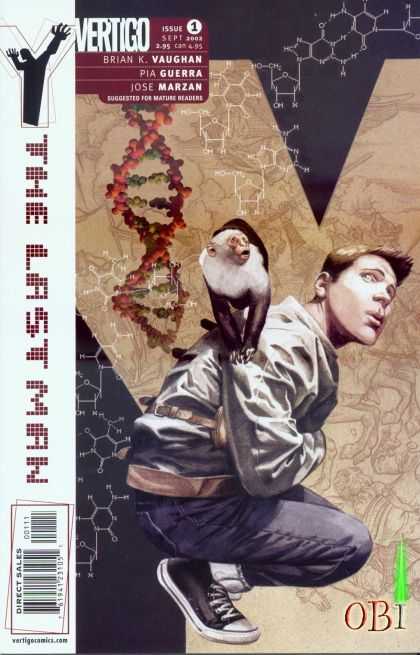
Y: The Last Man: Brian K. Vaughan and Pia Guerra

The premise of this comic is one of the most interesting I've ever come across. A disease sweeps across the entire planet, destroying every organism with a Y chromosome, human, animal, embryo and sperm alike – except for one guy, Yorick, and his pet monkey Ampersand. The characters are varied and interesting and I did grow to care about them, but what really keeps me thinking about this series is not so much them, but the things they see. As Yorick and his companions, Allison, a scientist, and 355, a secret agent, travel around the world, we see what has become of different civilizations as they recover from the catastrophic death of half their population. We find out who has filled the enormous power vacuum in nearly every field, from politics to military to trade. The ending was a little disappointing, just because it's hard to craft a conclusion big enough for such a fascinating and epic story.

--

So that's what I think about that stuff. Come back in a couple days for a link to Senseless. Then buy it!

Thursday, March 17, 2011

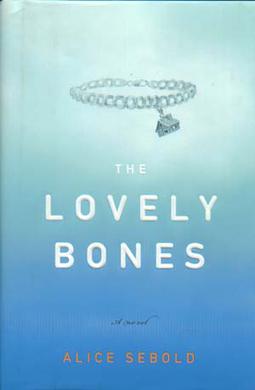
Lovely Bones


     I read The Lovely Bones by Alice Sebold for the first time a few years ago when a crazy cat lady on the bus my best friend gave it to me. Since then I have done something I don't do very often, which is periodically pick it up and read it again.

     The book is told through the point of view of Susie Salmon, a young girl who is raped and murdered very early in the story, so, understandably, reading it was a visceral experience. After Susie dies, the story becomes less about her and more about her family and the people who knew her, as she watches them from the afterlife in the years that follow her death.

     The one element that sticks out the most to me was the attention that Sebold gave to every single character, even the ones who hover briefly around the edge of the story and then disappear. In just a few sentences, she gives the reader one or two details about this person to make them as real and three-dimensional as Susie and her family, and to make the reader feel their unique pain, even if it is not directly related to the young girl or her death. There is Mr. Botte, a teacher of Susie's with a terminally ill daughter, and Artie, an awkward classmate with fixations that make him an outsider. The murderer, who we also watch through Susie's eyes, is opened up to the reader, even as we hate him for what he did.

     There was a major twist that alienated me a little bit because of how blatantly supernatural it was, and it felt out of place in a book that dealt so intimately with real emotions. Even after careful consideration, I still wonder if the book might have been better for its absence. But, aside from that, the story is lean and Sebold's style is fittingly simple and elegant, with just enough well-placed detail to make every page concrete and intense, without bogging down the narrative with redundant descriptions. To me, it was almost tangible, how much she cared about these characters and felt what they felt. It comes through in the authentic portrayal of their journey through grief, which is very different and personal for each character, from Susie's immediate family to a girl from school she barely knew. The point of view is perfect; we get to be with Susie as she progresses through the afterlife, and we get to watch the people she left behind as they grow up without her. Even though I was thrown for a loop with the twist, it certainly doesn't make me regret reading this book, as it is ultimately full of characters and scenes that have stayed with me for a long time.

Friday, March 11, 2011

The Hunger Games

     I had planned to kick off this blog with announcing that my short story had gone live on Kindle. But the formatting is still in process, so, because I'm very excited about this blog and all book stuff right now, I thought I would write a book review.


     Right after The Hunger Games was released in 2008, I read the first chapter online, here. I remember that I enjoyed it, but it seemed like it was a book for an audience younger than I, so that was all I did for a long time. Then, on a visit to Barnes and Noble, the cover caught my eye and I sat down to read it for a few minutes. I stayed in that chair for three hours until the store closed, then I bought the book and did not go to sleep until I had finished it.

     I loved the story, the characters, and the themes, but we'll get to those; the first thing that instantly charmed me was the world the author has created. The story takes place in a land called Panem, which is divided into twelve districts and a capital city. Parts of this place are so saturated with wealth and advanced technology that they start to do very silly things with their excess, like genetically augmenting their appearance; tinting their skin green, engraving gold patterns into their faces, and so on. In other parts of Panem, people are starving, and some of them get by with what they can kill with bows and arrows. I love science fiction and fantasy, and The Hunger Games balances the two genres in one setting believably and seamlessly.

     But an engaging setting isn't much with no one in it. The protagonist of the books is a teenage girl named Katniss Everdeen, who does not change much until the very end of the third book, when she suddenly changes a lot. But she is a well-written character; there are things about her not to like, as there should be, but she has been through a lot in her short life, and her strengths are appropriate for her history and they make her an admirable heroine. Her relationships with her mother and her younger sister are portrayed in a way that were deeply affecting even when they weren't front and center. Some of supporting characters, have their own rich back stories, and several of them became very important to me by the end of the book, but none of them have the same depth or vibrance as Katniss. The reader is given a number of very intimate glimpses into Katniss's past and her inner monologue, but they do not overpower the narrative or hold back what is a fascinating story.

     I will try to be vague about the plot in case you haven't read it, but there might be a few spoilers here. The story follows Katniss as she participates unwilling in a gruesome annual tournament, sponsored by a totalitarian government, that pits two teenagers from every district against each other in a lengthy fight to the death. There are numerous graphically violent scenes, but barely a whisper of sex so I guess that's why it is marketed as a book for young adults. The books really grow up as Katniss's situation and the situation of Panem as a whole becomes increasingly dire. There is an element of political strategy, as well some very profound, mature themes about government control, massive social class gaps, and the detachment that comes from watching tragedies on a screen instead of facing them yourself. Romance has its place, balanced well with the action and the larger story, and a love triangle develops. I was a little bemused by how hastily it was wrapped up (and almost wish it was not wrapped up at all) but Katniss's decision does make sense.

     The ending of the final book, Mockingjay, had a deeper impact on me than almost anything I have ever read. For a few days after I read it, I was angry at the author, not because it was poorly written but because it was so wrenchingly tragic. This spurs the massive, sudden shift in Katniss's character, to a point that I understood but that I had a little trouble sympathizing with. Nevertheless, heartbreaking as it was, the series wraps up in a very satisfying way, at a good point, and it has earned a high place on my list of favorite literature.

     That said, I am pretty apprehensive about the movie. This guy looks pretty beefy for Peeta Mellark, who is 16 and spends a lot of time painting or making cakes.