Wednesday, January 30, 2013

Flimsy Little Plastic Miracles by Ron Currie Jr


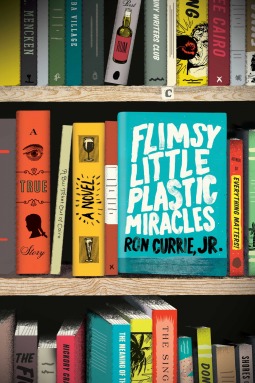
Flimsy Little Plastic Miracles, written by Ron Currie Jr., is about a man named Ron Currie Jr. Both are writers, both lost their fathers to illness, and apparently both are tragically in love with a captivating but unattainable woman. To escape, Ron Currie Jr (the character, not the author) retreats to a tropical island to drink and fight; there, he accidentally fakes his death, making his failed manuscript into a bestseller.
It might seem like I gave away most of the book in the first paragraph. But even though that storyline boasts more depth and late-game surprises than I expected, it’s overshadowed by the narrator’s musings about the Singularity, his father’s illness, and Emma, the woman he loves. These asides are frequent, often right in the middle of the action, but mostly they’re authentic; moving memories of his life or fascinating bits of technology history (did you know that robots once made the stock market crash more than 1000 points in just minutes?)

Sometimes, Currie the author slips into a self-conscious style, in which I can imagine him thinking a lot about people reading his book and what they might feel about it. I can understand that’s a hard mindset to break but it just served to disengage me here and there. Some of the characters seem too obviously crafted to fill a particular role in the story, sometimes even Emma, on whom the book spends a lot of time. On one page, we’re assured she’s not sad, she’s happy. On the rest of the pages, she seems very sad and impossibly beautiful and magnetic and every guy wants her but no one can have her, and I’ve seen that kind of character too many times.

Sometimes I think I would have preferred the book if it were distilled to the narrator’s relationship with his father, but I liked where Emma’s storyline led him and us, geographically and emotionally.

More from the author: Ron Currie Jr has two previous novels, God is Dead and Everything Matters!
--

If you think you want to read this book really soon, you can! In a week or so I’ll pick a random commenter from this post and send them a new hardback copy of this book. I’ll even autograph it. (Just kidding, I won’t, I know you don’t want that.)


Tuesday, January 1, 2013

The Darlings by Cristina Alger


For New Years, I decided to read more and hopefully have more content for the blog. Good timing because Penguin Books recently sent me a copy of a book in exchange for a review. 


“Necks still dripped with jewelry, the kind that spent the rest of the year locked away in a safe. Town cars and chauffeured Escalades idled out front. Of course, it was all an illusion…there wasn’t a single person in this room- not a one- who could claim they weren’t worried. They all were but they were dancing and drinking the night away as they always had…it was like the final peaceful moments at the Alamo.”

The Darlings by Cristina Alger centers around one of the wealthiest families in New York: Carter and Ines Darling, daughters Merrill and Lily and their respective husbands, Paul and Adrian. Set just after the market crash, it begins with a death that jars the already tense upper class of the finance industry. The Darlings are gradually sucked into the ensuing scandal and the crisis shines a light into the depths of each member’s relationships with their family.

There’s a considerable amount of financial jargon and most of it went over my head, so I might have missed out on some valuable tension because I didn’t understand some of the company relationships. But that’s not really the focus of the story; corporate corruption and scandal mostly serve as a backdrop to human problems like infidelity, fraught marriages, loneliness and fear of failure. Many of the characters have more money than I can imagine and there is a lot of worrying over an uncertain financial future while vacationing at a second home or throwing an opulent charity benefit. This was, at first, alienating. By the end, a few of the characters like Paul and Carter become very human; others such as Duncan, lawyer Sol and his wife Marion, provide a quick glimpse into something touching and identifiable, and others still feel so much like strangers that I can’t even remember them right now. There's  a fairly large cast of characters that continues to grow till the end of the book. True to real life, but a little disorienting for a novel.

The book boasts some glowing setting descriptions, from the view of an apartment on the Hudson River to the East Hamptons on the brink of winter. After a few pages of some awkward dialogue (an upper-class adult man repeatedly says “bro” and refers to beer as “mother’s milk”), Alger gets into her groove and for the rest of the book, character interactions become more natural, well-paced and serve to slowly build the tension. The ending- again, much like real life- didn't really close the story with a 'bang.' Part of me appreciates the realism in that decision and part of me was a little unsatisfied. 

Overall, while I wished for a little more closure, I enjoyed the immersion into the grandiose lives of big city millionaires and the attention given to complex familial connections. 


Wednesday, December 28, 2011

Koko Be Good, Blankets, and American Born Chinese

I picked these three comics for this post because I think they would go well next to each other on a bookshelf.


Koko Be Good: Jen Wang

This comic seems to be a reboot of a web series with the same name. At first, it revolves around two people who would probably be familiar to anyone who spent time in a hip college town. Jon is about to go off to Peru for some humanitarian work, and Koko is an impulsive, irreverent and directionless young woman. When the two of them meet, Koko is inspired by what she thinks is Jon's genuine selflessness. She decides to turn over a new leaf and be a good person. There is a third narrative, following a young man named Faron. Faron's story was interesting but I would have rather seen it in a comic of its own.

The art and the story work together to make give the book a dreamy, light mood. Koko is particularly expressive and the muted sepia palette warms it up. As for the plot, Koko's story was tough for me to buy and I didn't connect with her; I don't believe it would be so easy for a previously selfish and wild person to suddenly become 'good.' Jon's conflict with his older girlfriend gave me a few things to think about, and Faron's story was interesting but didn't fit and needed more space.

Blankets: Craig Thompson

A black and white graphic novel that tells the story of the author's early life: his relationship with his brother and parents, his struggles with faith, and the first girl he loved. I identified with the protagonist quickly, and I think a lot of people would if they had been disappointed by religion in the past. It also excellently captures the intensity of falling in love for the first time, and the heartbreak that usually follows.It's got me thinking about the way I experienced emotions when I was younger and the way I experience them now.

The art was energetic and fluid and full of motion. Thompson fills pages with lovely patterns reminiscent of Indian henna designs, and those were some of my favorites. Many of his full-page panels would make excellent posters.


American Born Chinese: Gene Luen Yang

 A simple, clean art style and a protagonist with an interesting perspective endeared this book to me. American Born Chinese flips between three very different stories: the Monkey King's struggle to change himself, Jin Wang's experience as a child of Chinese immigrants living in America, and Danny, an American boy inexplicably related to a ridiculous Chinese caricature named Chin-Kee. They tie together surprisingly but neatly for a satisfying conclusion. It balances light-heartedness with a lot of subtext on culture and alienation. 

Friday, September 2, 2011

The Strange Case of Finley Jayne


I found this book on my boyfriend's Kindle even though neither of us ordered it. So, I read it. It's about (surprise!) Finley Jayne, a young woman in steampunk Britain who has superstrength and a supertemper that cost her a job, and then immediately get her a way better one. She is hired by a woman concerned about her daughter's widower fiance, and thinks Finley is the right person to sniff out any weird stuff. I've never read a steampunk novel before and I'm not an expert on the culture so I can't say if it was anachronistic. However, I did enjoy the development of the setting and steampunk trappings, like the automaton horses and robot servants. Some of the character motivations come off as flimsy and unconvincing, but the heroine is pretty solid and it's a short, light read with a little bit of creepiness at the end.

This book is a prequel to The Girl in the Steel Corset, a longer story about Finley that looks like it explains more about the origin of her powers, which is not addressed in this book.

Wednesday, July 20, 2011

The Forest of Hands and Teeth

I'm editing and editing and drinking Red Bulls and editing and thinking back to the time when I thought I could finish this whole monster of a first draft by August. Oh, those were the days. I was so young and full of hope. Here's a book review.


I will read anything with a zombie on, in, or around it, and most of it is pretty bad. Forest of Hands and Teeth is not bad. It's pretty good, and that was a nice change. It's so easy to get lost in that I read it in a few hours without realizing it. The narrative is smooth and poetic, and the heroine, Mary, has more complexity and depth than I've usually found in the genre. There is more than enough zombie to make it at home in the genre, but the interesting stuff is Mary's relationship with religion, her mother's stories of a larger pre-zombie world, and two guys named Harry and Travis. In some parts, her emotions and reactions are described passionately while other parts seem curiously drab, which made me disengage for awhile. But for the most part, it's vivid, well-paced without bothering with too much description, and really not afraid to stomp on your heart. I'm looking forward to reading the other books because there is a lot left to learn about the world.

Monday, June 27, 2011

The Golden Acorn

Between editing The Girl from Wildwood, starting another book, going out of the country, and getting ready for Anime Expo, I somehow managed to read a few things. So here's a review of one of them. 


This book is free for Kindle on Amazon, which is cool. I thought it was light-hearted and enjoyable, simple to follow for younger readers. There isn't much to it, though; the protagonist, Jack, is likable, and so is his sidekick Camelin, but all of the other characters are completely flat. The world, based in Celtic mythology, is intriguing but underdeveloped and the explanations are convoluted. This is only the first book, so hopefully that can be fixed.

I don't want to pick on this book too much because it's probably for a younger audience and I think they'd like it well enough; the pace might lag a little in the middle, but the climax is suitably exciting and Jack is easy to root for. I was continually distracted by formatting issues and punctuation errors, though. I very much appreciate books being offered for free but it's still disappointing when they are poorly edited. 


Wednesday, March 30, 2011

Walking Dead, Black Hole, Y: The Last Man


Walking Dead: Robert Kirkman and Tony Moore/Charlie Adlard


The zombie genre may be reaching saturation, but I still read anything with an animated corpse on the cover. As a result, I've read a lot of crap: stories that try to implement a humorous or interesting twist, but fall short and miss out on that satisfying classic zombie apocalypse feel. I have also read a lot of formulaic zombie stories, that stick so closely to a pattern that they are utterly predictable. Walking Dead, a long-running comic that follows former sheriff Rick, walks a fine line in the middle. The series finds a good balance between flesh-eating monsters and the drama of people trying to work together and survive. It establishes its own zombie science, which is moderately original but retains all the typical zombie hallmarks. The main characters find unique refuges and meet with other survivors, some of whom are very disturbing. But it doesn't feel episodic; it satisfies curiosity by exploring the spectrum of reactions to the end of the world. The comic is at 82 issues right now and I'm still looking forward to the release of every one, but I already feel like the story has been slightly overextended, and I hope the series ends before its fans are exhausted.


Black Hole: Charles Burns 

I got this for my birthday, and I'm glad I did, because it's very different from what I usually read. Black Hole is centered around four teenagers in the middle of an STD epidemic that turns its victims into mutants. The art style is haunting and graphic, the story adeptly capturing the fear of ostracism, isolation, uncertainty, and apathy of late adolescence. Reading it was a surreal and uncomfortable experience because of the reoccurring imagery of its hallucination/dream/vision sequences, and its frequent brushes with sex, violence, and grotesque deformity. But it was compelling, and the climax of one character's story was as heartbreaking as anything I've ever read.


Y: The Last Man: Brian K. Vaughan and Pia Guerra

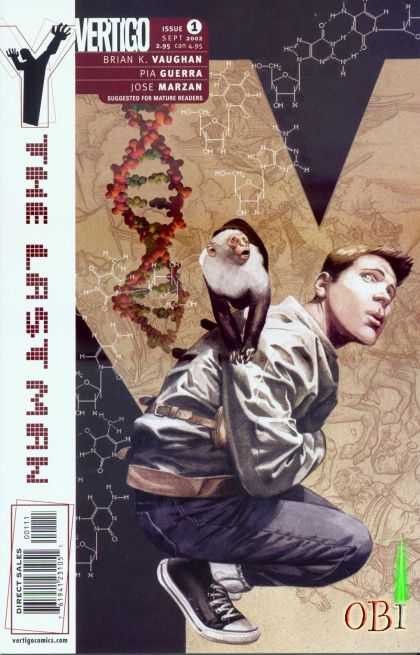
The premise of this comic is one of the most interesting I've ever come across. A disease sweeps across the entire planet, destroying every organism with a Y chromosome, human, animal, embryo and sperm alike – except for one guy, Yorick, and his pet monkey Ampersand. The characters are varied and interesting and I did grow to care about them, but what really keeps me thinking about this series is not so much them, but the things they see. As Yorick and his companions, Allison, a scientist, and 355, a secret agent, travel around the world, we see what has become of different civilizations as they recover from the catastrophic death of half their population. We find out who has filled the enormous power vacuum in nearly every field, from politics to military to trade. The ending was a little disappointing, just because it's hard to craft a conclusion big enough for such a fascinating and epic story.

--

So that's what I think about that stuff. Come back in a couple days for a link to Senseless. Then buy it!